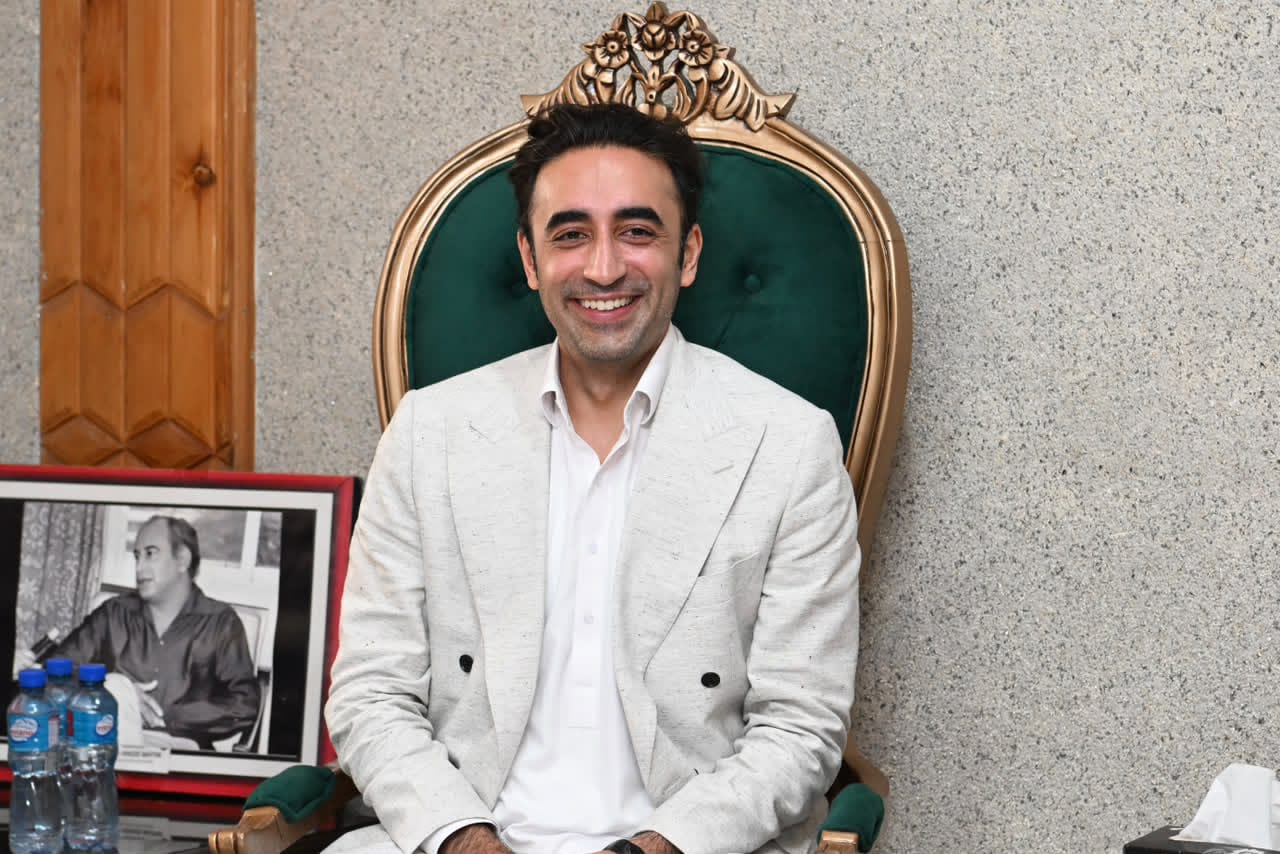
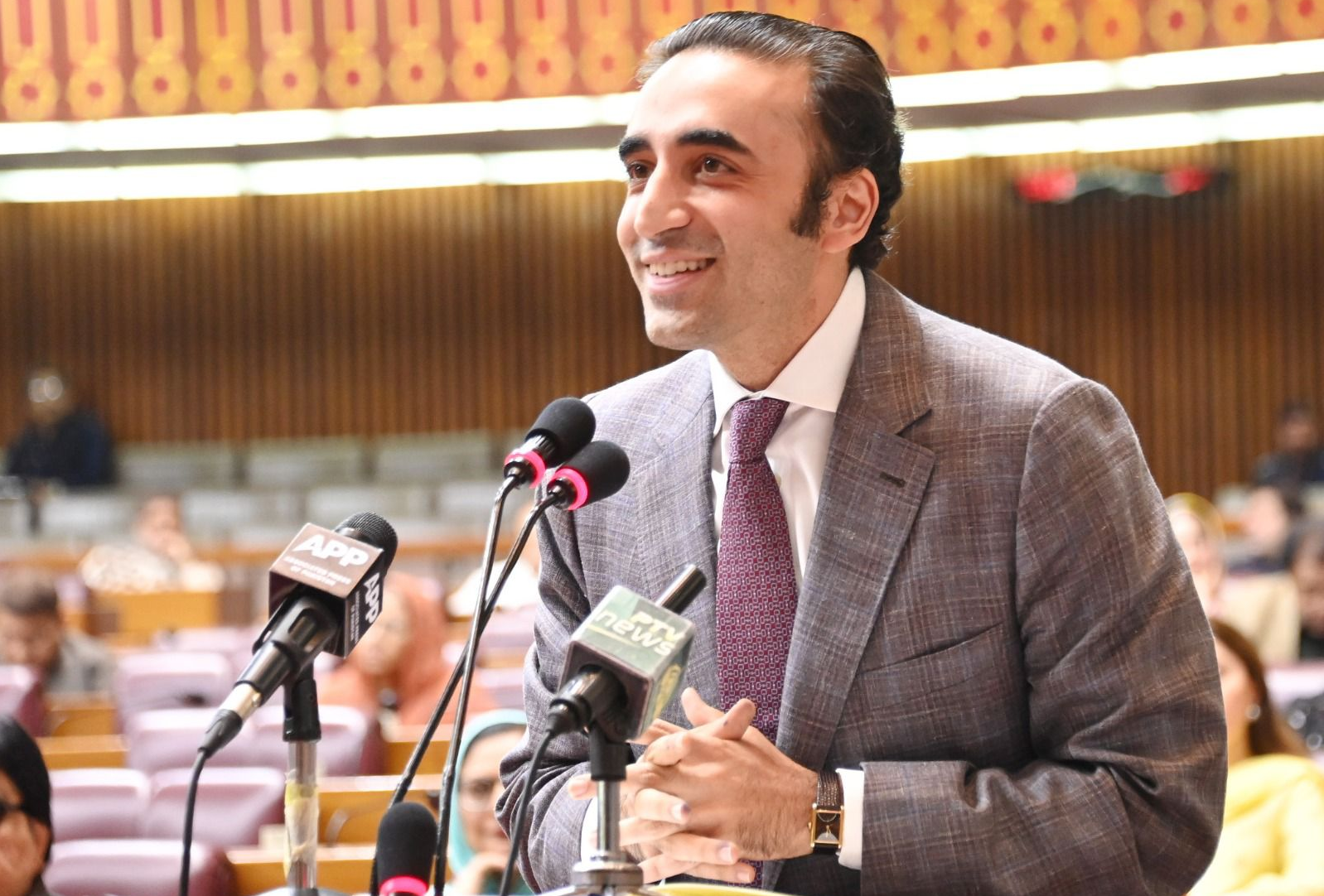
Chairman Bilawal addresses National Assembly budget session

Chairman Pakistan Peoples Party, Bilawal Bhutto Zardari addressing the budget session at the National Assembly said that the agreement between US and Iran is a new ray of hope for the region and the entire world. It is proof of dialogue being better than war, and diplomacy being more powerful than confrontation.

Chairman Bilawal extended felicitations to PM Shehbaz Sharif and President Asif Ali Zardari for always standing for peace. He paid tribute to Field Marshal General Syed Asim Munir and the Armed Forces for bringing pride to Pakistan through their leadership and defense of our country.

Bilawal Bhutto Zardari said that Pakistan knows the cost of war well. We have sacrificed our loved ones, combated terrorism and suffered through the economic consequences of uncertainty and instability. This is why Pakistan always raises the flag of peace because it is not just a moral obligation but an economic necessity. When peace prevails, trade increases, so does investment and employment. Countries do not attain greatness through might of weapons alone, but by giving hope and opportunity to the people, and support to the poor. Pakistan would too need to take a step towards progress, as the whole world is taking one towards peace.

The reality is that our region is not entirely peaceful even now, despite peace efforts between Iran and the US. Elements that want to harm the peace process exist. We are still facing security challenges on our Western border, the one we share with Afghanistan. On the eastern side, we are being threatened with an “Operation Sindoor 2” by India. One-sided efforts are being made for the Indus Water Treaty to become controversial. Foreign elements are supporting terrorism and trying to harm Pakistan.

During such situations, nations are tested. It gives me immense pride to say that Pakistan has handled this situation by displaying political consensus and democratic values. The federal and provincial governments have decided to shoulder the burden of extraordinary necessities owed to defense and national security. This decision has not been taken through any unconstitutional means, but is within the scope of the Constitution. This has been done in accordance with Article 164 through grants. Pakistan’s Constitution gives the federation and provinces the right to use grants in order to address needs that arise.

Chairman Bilawal said that friends in the media, prior to the budget, were speculating that the 18th Amendment would be abolished or that the rights of the provinces would be snatched, or perhaps the BISP would be discontinued. However, we are thankful to PM Sharif, DPM and FM Ishaq Dar, the Finance Minister and the entire team of the PM. We were engaged with the government to present a constitutional and democratic solution to fulfill the national security needs, as well as those of the provinces. We have decided that Sindh along with the rest of the provinces will also contribute to this. The federal government has pledged to keep the NFC Award intact for the provinces.

Chairman Bilawal said that the real strength of countries lies in their constitution and political unity. Pakistan has once again proved that it can uphold these values in today’s world. If we address the remaining issues in this manner, we can overcome any obstacle. Given this, he said that he would like to point out a recent precedent in Pakistan. There is an impression that provinces have more fiscal space than the federation after the 18th Amendment. Provincial governments too face economic constraints, from KP to Sindh. Despite the 18th Amendment and the NFC Award, no province has been given its due share. Time and time again, provincial governments have given sacrifices. During the 2008-2013 PPP government, in order to combat floods, we introduced a petroleum levy with the intent to aid flood victims. It is 2026 today, and that petroleum levy is being collected today along with several others, and provinces are not getting their share.This levy was a violation of the 18th Amendment and NFC Award. Every provincial government is told to show a surplus, which means that the amount is not spent on the people. The province of Punjab has made the greatest contribution and sacrifice in this regard. Last year, it showed a surplus of 700 billion rupees, and 900 billion rupees this year. That money can be spent on the people of Multan, DG Khan and Gujjar Khan. However, due to the IMF programme’s obligations, the provinces and their inhabitants are giving this sacrifice. The province of Sindh has shown a surplus of 400 billion rupees, which could have been spent on Lyaari, Korangi, Larkana and Nawabshah. Similarly, the KP province has its own challenges, it too has to show a surplus while it is not taken into account that tribal areas have recently been integrated with it. The federal and provincial governments have failed to deliver on their promises to the tribal chiefs.

Chairman Bilawal said that the Israel-India nexus intends to inflict harm upon us, through terrorism and our issues with Afghanistan. In light of this, all provinces have agreed to contribute. Not only the government and its allies, but the KP province which is being run by the Opposition has also decided to put political differences aside to take part in this effort. Chairman Bilawal welcomed this decision of the PTI, and said that if the Opposition continues to prioritise national interest, then there is no problem we cannot tackle.

Chairman Bilawal proposed that the federal and provincial governments have to work together to introduce a long-term and sustainable plan for growth-oriented economic policies after this budget is passed.

Chairman Bilawal Bhutto Zardari stated that it is unfortunate and shameful how the BISP has been targeted. He said that the first argument in its favour is that the world acknowledges the BISP, from reports of the World Bank to the IMF. If poverty is to be tackled, then the programme needs to be expanded, not the contrary. Chairman Bilawal especially lauded the PM for expanding the BISP despite the discourse against it. Millions of households have been supported through it, provided education to children and healthcare to new mothers and infants, and also joined relief efforts from floods to COVID. It has proved to be the most effective method, and not only is it humane but also Islamic. When the BISP helps mothers feed, clothe and send their children to school, it is not only an initiative, but also a moral and religious duty. The BISP is also good economics, since progress is not trickled down, but begins from the downtrodden. The poor do not put money into banks, but rotate it in the economy and support small businesses. The BISP also provides supports to national security, at a time when there is insurgency, religious extremism and separatism that is foreign-backed. Every army in the world knows that any insurgency is not battled by weapons alone, but the hearts and minds of the people need to be won. A country which wins the hearts of its people cannot be defeated, Chairman Bilawal said. The PPP will always defend the BISP, he resolved.

Chairman Bilawal said that the agricultural economy of the country does not prosper when big landowners do, but when the small farmers do. Similarly, the economy does not progress when the mill owners do, but when the labourers get their due share. The progress of Pakistan is not the rich getting richer, and the poor getting poorer, but when the young people are given employment opportunities. When the government decides that the fruits of progress are to be given to the people of Pakistan and the downtrodden first, then the country will prosper. Chairman Bilawal recalled talking to a counterpart when he was the FM, and detailing the potential of the CPEC and the roads that are being constructed as well as the Orange Line train. He was asked by the foreign FM about the route change in CPEC, and the western route being built first, where already developed areas were to be benefited. He said that if the eastern route was prioritised, then areas in KP and Balochistan which had been impacted by terrorism would be benefited, and more economy opportunities would be created. He further said that to build a train, the loan must have been substantial, and instead, if that money had been allocated to build Gwadar further, every city of Pakistan would have its own Orange Train, and not on a loan. The objective of retelling this story is to introduce growth-oriented projects so that the country is not run on loans but experience true progress, which is not limited to specific areas.

Chairman Bilawal expressed his gratitude to the people of Gilgit Baltistan for reposing trust in the PPP, and giving it a clear lead with 11 seats, with our representative being elected from every division. He said that they have shown him and Aseefa Bhutto Zardari that the people are still standing with the party of Shaheed Zulfikar Ali Bhutto. They are the most patriotic people in all of Pakistan, and are the nation that fought and freed them themselves to become a part of Pakistan. Chairman Bilawal asked what we did for them in return. We gave them the system of the FCR instead, which was abolished by Shaheed Zulfikar Ali Bhutto. This laid the foundation for the relationship between the PPP and the people of GB. Then, they were left without any support again, until Shaheed Mohtarma Benazir Bhutto gave them political rights. Then, President Zardari gave them an identity, and a governor and CM during the PPP’s era. Chairman Bilawal said that he has promised governing, ownership and employment rights to the people of GB.

Chairman Bilawal said that the PPP has shared historic ties with Kashmir. Having served as the youngest FM, he asked how long the people of Kashmir would remain deprived of the right to join us in this House. He said that their representatives should be permitted to sit in this House on an interim basis and present their views. Until a plebiscite takes place, it is my request to this House, and the institutions to heed this demand.

Chairman PPP said that certain developments in Kashmir have sparked concern. It is no secret that a day prior to the Iran-Israel war, Netanyahu had hosted the same Modi who is adamant on there being an Operation Sindoor 2. Every Pakistani is aware of the challenges we face in Balochistan, and that an Indian agent, Kulbhushan Jadhav was caught from there too. Moreover, certain separatist elements had even welcomed the Israeli attack on Iran. When the Israeli IDF is exhausted from killing children and carrying out a genocide, they go to IOJK to spend their vacations and do high altitude trainings. Now, even when the war is over, this nexus will continue to target us. We have to collectively ensure that the enemies are not to take advantage of our fault lines.

Regarding the situation in Azad Kashmir, Chairman Bilawal said that those that equip themselves with weapons against the state and people, they have to face the consequences before the law. Whatever is happening in Kashmir is not only hurting our reputation, but the Kashmir cause. Our demand to them is to disperse, since we will not let them harm the cause or Pakistan. Chairman PPP said that his only mandate to the government in Azad Kashmir was to implement the agreement and then head towards elections. Eighty percent of the agreement was implemented on, what is remaining are long-term points, funding needs to be discussed with the federation, and we need to build consensus with other parties as well. He said that the manner in which the protest is being carried out is raising problems for the Kashmiri people, and they cannot access basic facilities. The protestors should themselves hand over those individuals that have taken law into their own hands to the AJK police. He said that the organisation has not ever contested any election.

Chairman Bilawal said that no other province would accept their legislative numbers being determined from elsewhere. This becomes a question mark. Our stance is that the decisions of Kashmir will be made by the people of Kashmir themselves. Now, this is a complication, however, no one’s property or life should be threatened for this. This can be addressed with a debate, but not by force and guns. We strived three decades to restore the 1973 Constitution. This is not how changes are made. We need to convince the Muslim Conference and the Muslim League on the appropriate consensus. Our party’s stance is that we cannot compromise on the representation and votes of muhajireen. Our objective is to resolve their legitimate grievances without compromising on the votes of the muhajireen. Only Kashmiris will make decisions for Kashmir, Chairman Bilawal said. PPP’s suggestion is that the muhajireen seats should be decided per the elections in Kashmiri areas, and allotted like a ratio, to ensure the representation of muhajireen, as is done for reserved seats. It should also be ensured that muhajireen are given the right to vote. Chairman Bilawal said that he does not appeal but insists the protestors to protect the Kashmir cause, and conduct themselves in a political manner. He said that a few weeks ago, Mehbooba Mufti in her speech said that there is freedom and peace in AJK but not in Occupied Kashmir. Those protesting would have to disperse, and sit with political parties to devise a solution. This challenge requires us to break from the mould and the status quo. Those participating in the upcoming elections in Kashmir would have to decide whether they want to take part in traditional politics or strive for their rights. As a mature political party, we want to give a new manifesto the people of Kashmir, and the PPP will take part in these elections, as we did in GB elections.

Chairman Bilawal said that the Kashmiri people are given the right to speak up, then the choice they make will be even clear. Despite Modi’s efforts from Balochistan to Kashmir, this House is willing to combat all efforts and conspiracies. Modi says that he does not accept the Indus Water Treaty, but the entire Pakistan is ready to fight for it because it is our survival. We appreciate what DPM FM Dar and his team is doing on an international level. Internally, Pakistan needs to ensure that its ongoing projects are completed. Outside of the Indus Water Treaty, Pakistan needs solutions to address water issues. The agricultural loss of Balochistan and Sindh is not theirs alone, but of Pakistan. Pakistan should take no such step that gives the impression that we are accepting defeat or giving up on the Indus Water Treaty. President Zardari’s pipeline project with Iran is a hot topic these days, but another one of his projects is Pakistan getting water through Central Asian republics. A 3 million dollar feasibility study has also been done in this regard, and if we follow these recommendations, we can address and resolve all issues as we stand at a crossroads.


.

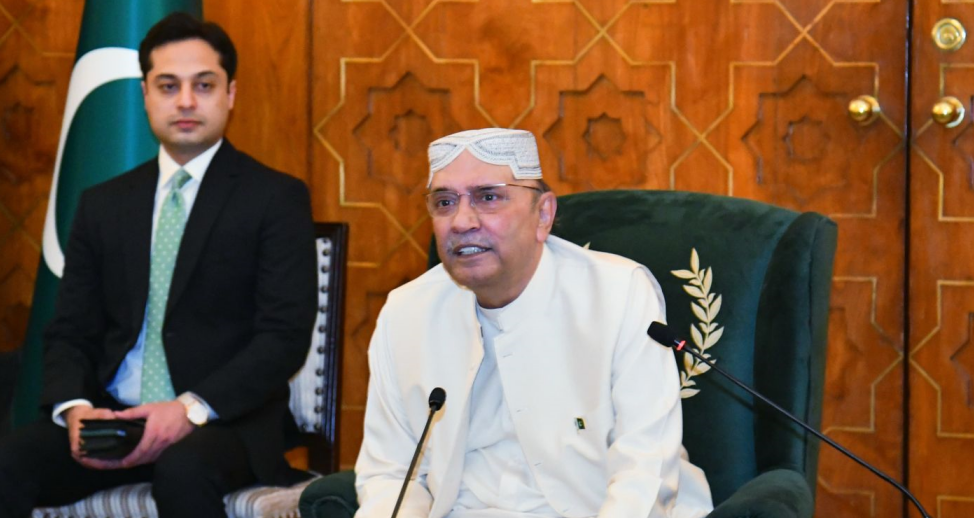
PRESIDENT ZARDARI WELCOMES SIGNING OF ISLAMABAD MEMORANDUM OF UNDERSTANDING

President Asif Ali Zardari has warmly welcomed the signing of the Islamabad Memorandum of Understanding between the United States of America and the Islamic Republic of Iran, describing it as an historic moment for the region and the world.

In his message, the President said that the conflict which began in February 2026 inflicted immense suffering upon the peoples of the region and caused severe disruption to global energy supplies, trade and economic stability.

He expressed hope that such a tragedy would never be repeated and that the nations of the region would now devote their energies to development, prosperity and the well-being of their peoples.

The President paid tribute to Prime Minister Muhammad Shehbaz Sharif, Deputy Prime Minister and Foreign Minister Senator Mohammad Ishaq Dar, Field Marshal Syed Asim Munir COAS and Minister for Interior Mohsin Naqvi for their tireless diplomatic efforts that contributed significantly to bringing the parties to an agreement.

He noted that Pakistan had played a principled, balanced and constructive role throughout the crisis, consistently calling for dialogue, restraint and a peaceful resolution of disputes while maintaining engagement with all parties concerned.

President Zardari also appreciated the leadership of President Donald Trump, His Eminence Ayatollah Seyyed Mojtaba Hosseini Khamenei, President Masoud Pezeshkian and Foreign Minister Abbas Araghchi for ensuring a diplomatic resolution of the conflict and advancing the cause of peace.

President Zardari also acknowledged the valuable support of brotherly nations, including Qatar, Saudi Arabia, Türkiye and Egypt, as well as the Russian Federation and China, whose efforts and encouragement of dialogue contributed to the pursuit of peace.

The President called upon all parties to implement the IMoU fully and expedite efforts to reach the final agreement within the stipulated timeframe to ensure lasting peace and progress.
“Heroes are those who have ended the war, not those who are eager to start one,”the President said.

He expressed the hope that this MoU that has Islamabad and Pakistan written all over it, would serve as the foundation for a durable and comprehensive peace in the region, enabling nations to focus on economic development, energy cooperation and the advancement of their peoples.

“War brings nothing but destruction and misery. Peace is the only path to progress,” the President said. “Pakistan will continue to stand in solidarity with all brotherly nations of the region in their collective journey towards peace and prosperity.”


.

Message of the President of the Islamic Republic of Pakistan on the Occasion of the International Day for Countering Hate Speech

On the occasion of the International Day for Countering Hate Speech, I join the international community in reaffirming the importance of promoting respect, tolerance and understanding among people of all faiths, backgrounds and cultures. Hate-driven narratives, prejudice, incitement and discriminatory attitudes not only undermine social harmony but also pose serious threats to peace, human dignity and peaceful coexistence among nations. In today’s interconnected world, the spread of hatred is no longer confined to a particular society or region. It transcends borders and affects collective peace, stability and development.

Islam is a religion that upholds the values of compassion, tolerance, justice, moderation and respect for humanity.

The Holy Qur’an guides us to adopt civility, wisdom and righteousness in our speech and conduct. Allah Almighty says:
“O believers! Be mindful of Allah, and say what is right.” (Qur’an 33:70)
The Holy Qur’an further instructs:
“Speak kindly to people.”(Qur’an 2:83)
Allah Almighty also says:
“Repel evil with what is better.” (Qur’an 41:34)
The Holy Prophet Muhammad (peace be upon him) said:
“Whoever believes in Allah and the Last Day should speak good or remain silent.” (Sahih al-Bukhari and Sahih Muslim)
He also said:
“A Muslim is one from whose tongue and hand the Muslims are safe.” (Sahih al-Bukhari)

In the digital age, social media and modern communication platforms have significantly expanded opportunities for expression. However, this freedom carries a responsibility to ensure that our words are guided by truth, wisdom and respect for others. Irresponsible discourse and hate-filled content fuel division, mistrust and violence, thereby weakening the fabric of society.

Pakistan is a diverse society comprising people of different faiths, sects, cultures and linguistic backgrounds. Our Constitution guarantees equal rights, religious freedom and the dignity of every citizen. Our collective strength lies in unity, mutual respect and tolerance. It is therefore imperative that we continue to promote interfaith harmony, inter-sect understanding, constructive dialogue and national cohesion.

Hate speech affects people in their daily lives, whether in schools, workplaces, places of worship or online spaces, creating divisions and undermining mutual trust within communities.

On this occasion, I call upon religious scholars, educators, media professionals, civil society organizations, academic institutions and particularly our youth to play an active role in countering hate-based narratives and fostering a culture of respect, empathy, and constructive engagement. The challenge of hate speech cannot be addressed through legal measures alone. It also requires education, moral development and sustained efforts to build awareness and understanding.

Let us reaffirm our responsibility to ensure that our speech, writing and conduct reflect the highest ethical values and the teachings of our faith. Each of us has a role in shaping the tone of public discourse. By choosing respect over hostility and dialogue over division, we can help build a society where differences are addressed through understanding rather than hatred.

May Allah Almighty bless Pakistan with peace, stability, unity and prosperity, and guide humanity towards greater understanding, harmony and mutual respect.

Pakistan Zindabad.

.

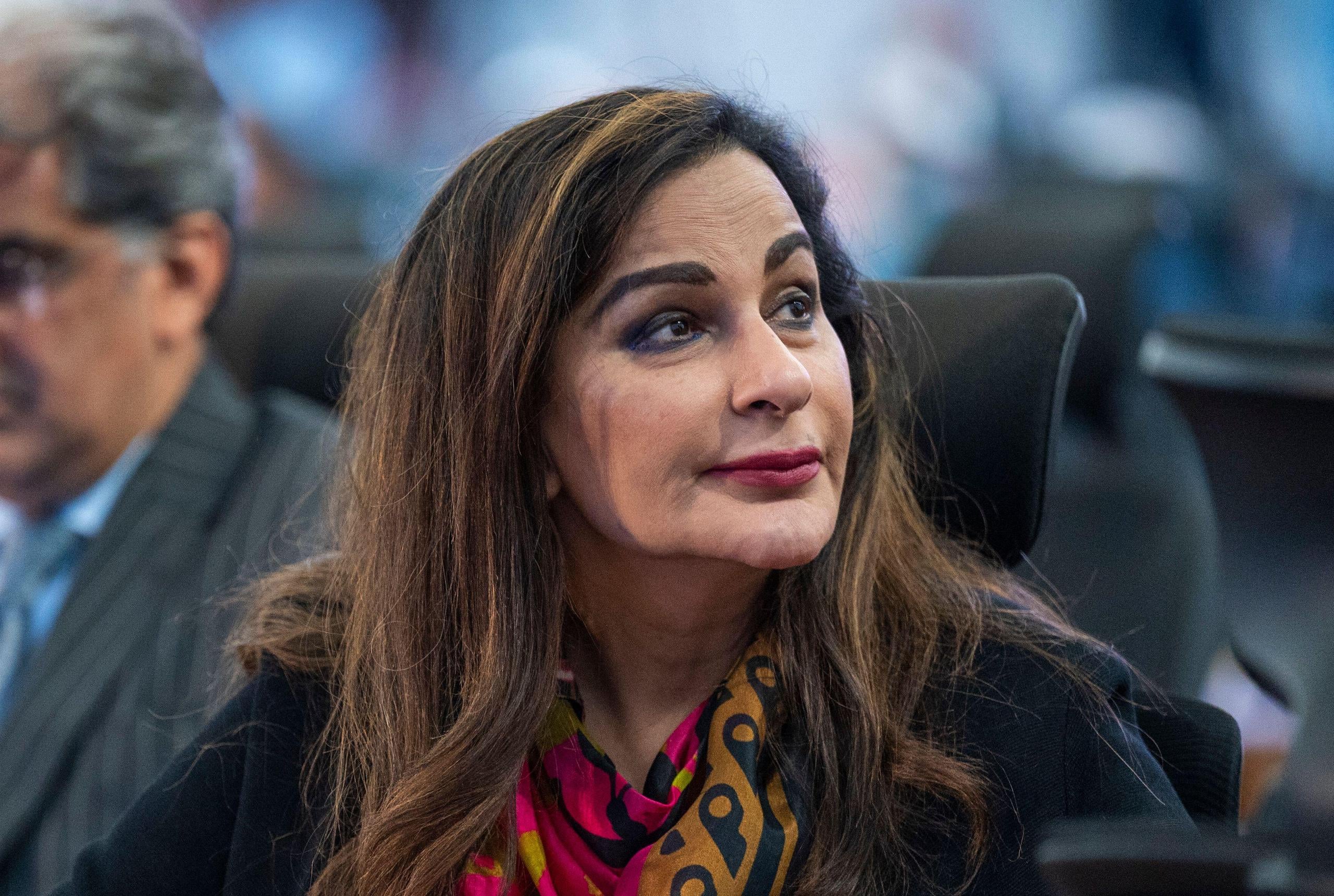
Vice President of the Pakistan Peoples Party Senator Sherry Rehman, while speaking in the Senate today

Vice President of the Pakistan Peoples Party Senator Sherry Rehman, while speaking in the Senate today, congratulated the nation on what she termed a major diplomatic achievement, highlighting Pakistan’s constructive role in facilitating peace efforts amid tensions between Iran and the United States.

“Pakistan invested in hope, dialogue and diplomacy. The international community has acknowledged and appreciated these efforts” she said.

She noted that Prime Minister Shehbaz Sharif had acknowledged the contributions of President Asif Ali Zardari, PPP Chairman Bilawal Bhutto Zardari and the wider political leadership in supporting these diplomatic efforts.

Referring to the broader regional impact of peace, Senator Rehman said that stability in the Strait of Hormuz would strengthen global energy security, improve supply chains and contribute to greater price stability.
“We hope that reduced tensions will ultimately help bring down oil prices globally and in Pakistan, easing inflationary pressures and providing relief to ordinary citizens, particularly vulnerable households already struggling with rising costs,” she added.

“With almost 45 percent of our population living below the poverty line, lower international energy prices offer much-needed relief to ordinary citizens. Peace is not only a diplomatic achievement; it is also an economic necessity for millions of people,” she said.

Based on this Senator Rehman said that while the current budget offered economic stabilisation it does not solve growing fundamental challenges.

Referring to the Rs 18 trillion federal budget, she called for a more equitable taxation structure that increases direct taxation while reducing dependence on indirect taxes and sales taxes that disproportionately impact lower-income groups.
“The country’s fundamental problem is that it is living on borrowed money, which is clear when you see almost 50 percent of expenditures go into debt servicig. To change that Pakistan has to broaden the taxation pool, which is no rocket science. Trade and service sectors need to contribute far more to national revenues to be able to fix the gaping hole at the heart of the budget. At the same time Pakistan cannot continue relying on the same taxpayers while large segments of the economy remain undertaxed,” she said.

Senator Rehman said that only regressive levies that leached money away from the federal divisible pool were growing instead of being tapered off to the provinces as sales taxes, so that social spending can he enhanced. Our provinces have to yield up taxation to the federal government there will be no expenditure on social programs. She expressed serious concerns over the continued expansion of the petroleum levy, noting that it was originally introduced as a temporary measure.
“There is a clear difference between a tax and a levy. Levies do not flow to the provinces, while provinces are responsible for delivering health, education and other essential public services. When levies continue to rise, provinces lose fiscal space and are often forced to cut development spending. The petroleum levy is increasingly functioning like a sales tax which diverts money from the provinces, she said.

She added “Provinces have demonstrated stronger performance in taxing services whereas there is a crisis of revenues not matching expenditures at the centre.

Reiterating the importance of provincial empowerment, Senator Rehman said that increasing levies under the guise of taxation should not come at the expense of provincial financial rights.
“Health and education are delivered largely through the provinces. If we want better outcomes for our citizens, provinces must have the fiscal space and resources necessary to perform these responsibilities effectively,” she said.

Senator Rehman noted that approximately 42.8 percent of the federal budget was being absorbed by debt servicing, including both interest and principal repayments.
“When nearly half of the federal budget is consumed by debt obligations, the space available for development, social protection and public investment becomes severely constrained,” she said.
On the expenditure side we see a complete imbalance. An entire country’s PSDP plan costs less than the expenses of the federal government. At rupees one trillion the federal government is not just running ministries that should have devolved long ago but it is also erecting more parallel structures like Authorities to go along with redundant federal ministries. This is a recipe for government bloat. At the same time state-owned enterprises continue to place a staggering burden on public finances.
“Losses of state-owned enterprises reached Rs 832.848 billion in FY2025, with cumulative losses now standing at Rs 6.563 trillion. Yet another Rs 451 billion has been allocated to SOEs in this budget. This is a structural challenge that cannot be ignored indefinitely,” she added.

Senator Rehman welcomed the removal of the 18 percent sales tax on sanitary pads and contraceptives, describing it as an important step towards improving affordability and access to essential products for women and families.
She further stressed the need to create stronger incentives for businesses, stimulate growth and address unemployment, which currently stands at approximately 7 percent.

Senator Rehman also expressed concern over declining climate allocations despite Pakistan’s growing climate vulnerabilities.
“It is deeply concerning that climate-related levies are being collected with no clear path of those funds into decarbonisation. Especially while climate financing remains inadequate and climate budgets continue to shrink. Pakistan is among the countries most vulnerable to climate change, and this is precisely the time when climate investment should be increasing, not decreasing,” she said.

She noted that climate impacts were already affecting agricultural productivity and food security.
“Pakistan was once a net exporter of major commodities such as wheat, cotton and sugar. Today, climate pressures and longstanding structural challenges have increased our dependence on imports. This trend should concern all policymakers,” she warned.

Concluding her remarks, Senator Rehman called for a more inclusive budget-making process, where tax collection gaps were addressed. One of the better solutions might be to give sales tax on goods to provinces as well, given the fact that their record of collecting is much better than FBR. She urged consultations to begin in January well before the presentation of the next budget.

.

Chairman Pakistan Peoples Party Bilawal Bhutto Zardari has welcomed the conclusion of the Peace

Deal between the United States of America and the Islamic Republic of Iran.

“I warmly welcome the conclusion of Peace Deal between the United States of America and the Islamic Republic of Iran, an important first step towards reducing tensions and advancing peace through dialogue. This positive development reflects the statesmanship and commitment of all parties involved.

“I commend Prime Minister Muhammad Shehbaz Sharif for his leadership and vision in facilitating this process, and Field Marshal Syed Asim Munir for his steadfast support for regional stability.

“I also acknowledge Deputy Prime Minister and Foreign Minister Senator Mohammad Ishaq Dar, the Ministry of Foreign Affairs, and the dedicated diplomatic teams from all participating countries whose professionalism, perseverance, and quiet efforts behind the scenes helped make this achievement possible.”

.

President expresses deep grief over PAF trainer aircraft crash near Mardan, pays tribute to martyred officers

The President of Pakistan, Asif Ali Zardari, has expressed deep grief over the crash of a Pakistan Air Force trainer aircraft near Mardan.

The President paid tribute to Flight Lieutenant Muhammad Qasim Abdullah and Lieutenant Taha Abbasi, who embraced martyrdom in the incident.

He prayed for the elevation of the ranks of the martyrs and fortitude for the bereaved families.

The President said the nation will always remember the sacrifices of its brave sons who laid down their lives in the defence of the homeland.

He also expressed heartfelt sympathy and condolences with the grieving families.

.

PPP Chairman Bilawal Bhutto Zardari said, “The imminent signing of the Islamabad accord marks a historic moment.

PPP Chairman Bilawal Bhutto Zardari said, “The imminent signing of the Islamabad accord marks a historic moment. At a time when the international spotlight is firmly on Pakistan, the ongoing unrest in Azad Jammu and Kashmir is damaging both the Kashmiri cause and Pakistan’s reputation. It is also creating an unnecessary opportunity for hostile actors and the India-Israel nexus to exploit the situation for their own purposes.”

He said, “I therefore appeal to all protestors to bring their demonstrations to a peaceful conclusion. Those individuals who have taken the law into their own hands should surrender themselves to the local authorities and allow due process to take its course.”

Bilawal Bhutto Zardari said, “All political grievances and disagreements must be resolved through democratic, constitutional, and peaceful means. Parliament and the political process—not the streets—are the appropriate forums for addressing and settling such issues.”

He said, “The Pakistan Peoples Party has already called upon the Election Commission to withdraw its premature election schedule. We remain committed to pursuing a political solution and would seek to establish a Truth and Reconciliation Commission to address outstanding grievances, move the process forward, and bring these matters to a just and lasting conclusion. The people of Kashmir should not have to endure repeated cycles of protest, confrontation, and uncertainty.”

The PPP Chairman further said, “If all stakeholders, including the Federal Government, are in agreement, the AJK Government could, in due course, review the notifications issued in relation to protesting parties. While there can be no compromise when it comes to upholding the rule of law and holding accountable those who have engaged in unlawful acts, we are equally committed to ensuring that individuals who have done nothing wrong are not made to suffer the consequences of the actions of others.”

.

Message from the President of the Islamic Republic of Pakistan on World Day Against Child Labour (12th June 2026)

Today, on World Day Against Child Labour, Pakistan joins the international community in reaffirming its resolve to protect children from exploitation and to ensure that every child can grow up in safety and attend school.

The protection of children is rooted in the Constitution of Pakistan. Article 11 prohibits slavery, forced labour and the employment of children in hazardous work, while Article 25-A guarantees free and compulsory education for all children between the ages of five and sixteen years. These provisions define a clear responsibility for the State to safeguard childhood and support education.

Child labour has direct consequences for a child’s life and future. A child engaged in work is often forced to leave school or fall behind in learning. This limits opportunity, weakens skills development and places additional pressure on families already facing hardship. Ensuring that children remain in education is therefore not only a matter of protection, but also of long-term social and economic well-being.

Pakistan continues to take steps at federal and provincial levels to reduce child labour and strengthen child protection efforts. The focus remains on prevention, enforcement of existing laws and support for children who need to return to education and a stable environment.

On this day, I call upon parents, employers, teachers, religious leaders, civil society and all citizens to play their part in protecting children from exploitation and keeping them in school.

A society is judged by how it treats its children. Every child in Pakistan must have the opportunity to learn, to grow and to build a secure future.

.

Chairman Pakistan Peoples Party (PPP) Bilawal Bhutto Zardari has said that children are not merely the future of the nation

Chairman Pakistan Peoples Party (PPP) Bilawal Bhutto Zardari has said that children are not merely the future of the nation but its most precious trust, and that a society cannot claim progress while its children are deprived of their right to education, safety, and a carefree childhood. Calling for renewed national and global commitment to ending child labour, he stressed that every child deserves a life filled with learning, hope, dignity, and opportunity—not exploitation, deprivation, and burdens beyond their years.

According to the press release issued by the Media Cell Bilawal House, the PPP Chairman, in his message on the occasion of the World Day Against Child Labour, pointed out that the 1973 Constitution—the historic gift of Quaid-e-Awam Shaheed Zulfikar Ali Bhutto to the nation—prohibits slavery, forced labour, and the employment of children in hazardous occupations, while also guaranteeing free and compulsory education for all children between the ages of five and sixteen. He said these constitutional safeguards reflect the state’s responsibility to protect children and secure their future.

Reaffirming the Pakistan Peoples Party’s commitment to the vision of Shaheed Mohtarma Benazir Bhutto, Chairman Bilawal Bhutto Zardari said that she firmly believed that every child, regardless of background or circumstance, deserves an equal opportunity to learn, grow, and contribute to the nation’s progress.

The PPP Chairman urged governments, employers, civil society, and communities to work collectively to eradicate child labour in all its forms and create conditions in which every child can live with dignity, security, and hope. “Let us build a society where children are known not by the work they are forced to do, but by the dreams they are empowered to pursue,” he concluded.

.